
What is contract-grade retail furniture?
Unlike home furniture, contract-grade furniture is built to withstand hundreds of users a day. Three measures set it apart: a high Martindale figure, a repeatable module standard, and a fixed delivery date tied to the store opening schedule.
· Valentinos Luxury · 3 min read
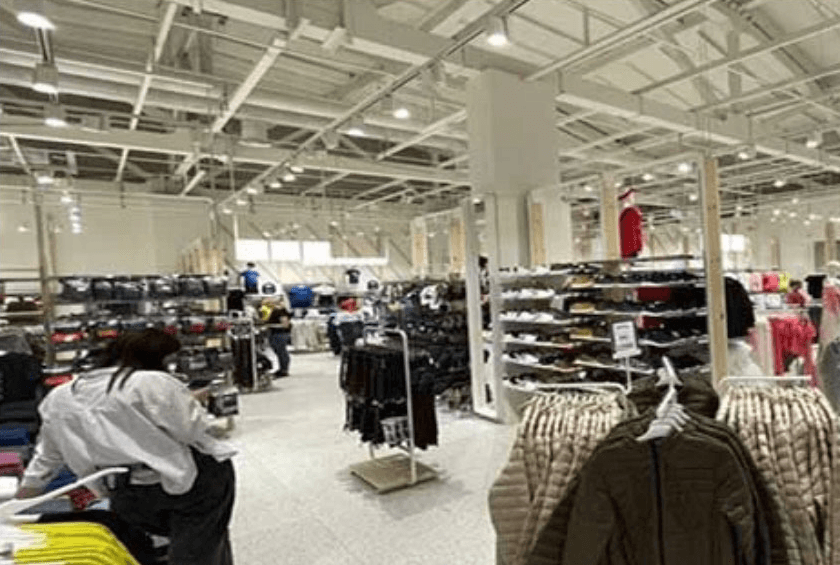
Contract grade is not a quality label — it is a use class. Home furniture is built for a family’s daily use; contract-grade furniture is built for an environment where hundreds of people a day touch it, pull it and lean on it.
That distinction shows up in three places: material durability, module standardisation and schedule discipline.
Material durability
Fabrics are specified at 40,000 Martindale cycles and above, against a lower limit of 20,000 for home furniture. On surfaces, impact and scratch resistance come first: high-pressure laminate (HPL) or thick melamine is chosen over lacquer.
For hardware, the cycle count decides. A shop drawer goes through in a few months what a domestic drawer sees over years, so runners and hinges are chosen against test certification.
Edge banding is applied at 2 mm on every visible surface, and corners in customer traffic get an additional impact profile.
Module standards and repeatability
A retail chain does not buy furniture for one store; it repeats the same layout across 5, 20 or 60 of them. So in contract work you design a system rather than a product: module widths, connection details and assembly sequence are all standardised.
That standard has to adapt to stores of different sizes. The same shelving system must work in an 80 m² store and a 400 m² one. It does so by keeping the module width fixed and the number of runs variable.
The assembly guide and numbering system are part of that standard too. Installation teams in different cities read the same guide.
Schedule discipline
A store opening date is tied to the lease and cannot be pushed back. That is why the delivery date in contract work is fixed, and the production plan is built backwards from the opening.
The approval sample is the first step in that schedule: before series production begins, one module is built full-scale, the client approves it, and series production follows that sample. The sample takes 2–3 weeks.
In series production, capacity decides. We work at a capacity of 40 containers a month across our 14,000 m² facility, and every project is assessed against that capacity before it goes into the schedule. We do not quote a date we cannot meet.
Where the scope begins and ends
In contract work the scope starts with the architectural drawings. The module layout is worked out from the store design, the production file is prepared, the approval sample is built, series production runs, shipping is planned and on-site assembly completes the job. Every one of those steps sits with a single team.
For overseas stores, shipping and customs documentation are part of the scope too. We have shipped to 26 countries to date; the store projects in Moldova, Ukraine and Kosovo are listed with their details on the Projects page.
What it shares with home furniture
It is made in the same workshop, against the same 24-point checklist. Contract work does not run on a separate line — it is built in the same facility, and a workshop that can produce retail furniture holds itself to different tolerances on home furniture too.
Frequently asked
- Can contract-grade furniture be used at home?
- It can, and it is durable, but the material choices are driven by durability rather than looks. For home furniture we prefer lacquer and wood veneer; in contract work HPL and thick melamine come first.
- How many stores can a project cover?
- We work project by project, assessing anything from a single store to a multi-branch chain against available capacity; that capacity is 40 containers a month.
- How long does the approval sample take?
- The approval sample is produced in 2–3 weeks. Series production then follows the approved sample.
- Do you prepare the architectural drawings?
- The architectural drawings sit with the client or their architect. We work from those drawings to produce the module layout and the production file.